Pulse oximetry that works
for every patient

Current pulse oximeters have a skin-tone bias problem. Oxyvera is building the sensing technology to fix it.

Our approach Read the research
The Problem

Skin tone changes what a
pulse oximeter actually measures

Pulse oximeters work by shining light through tissue. Melanin, skin thickness, and hydration all alter the optical signal before it reaches the blood, and most devices were never designed to account for this.

The result is a well-documented disparity: patients with darker skin are more likely to receive inaccurate SpO2 readings, including readings that appear normal when hypoxemia is present.

The underlying cause is physical, not incidental. It requires a sensing solution, not a more diverse validation population.

Sjoding et al., NEJM 2020
Occult hypoxemia missed nearly 3x more often in Black patients
Analysis of ~10,000 paired arterial blood gas and pulse oximetry measurements from ICU patients across two health systems.
FDA Safety Communication, 2021
FDA warns of pulse oximeter limitations across skin tones
FDA advisory formally recognized that pulse oximeter accuracy may be affected by factors including skin pigmentation, recommending clinical decisions not rely on oximetry alone.
Our Approach

Measure the medium.
Not just the signal.

Conventional oximeters treat skin variability as noise to be filtered out. Oxyvera treats it as a measurable physical property that must be characterized before SpO2 can be accurately estimated.
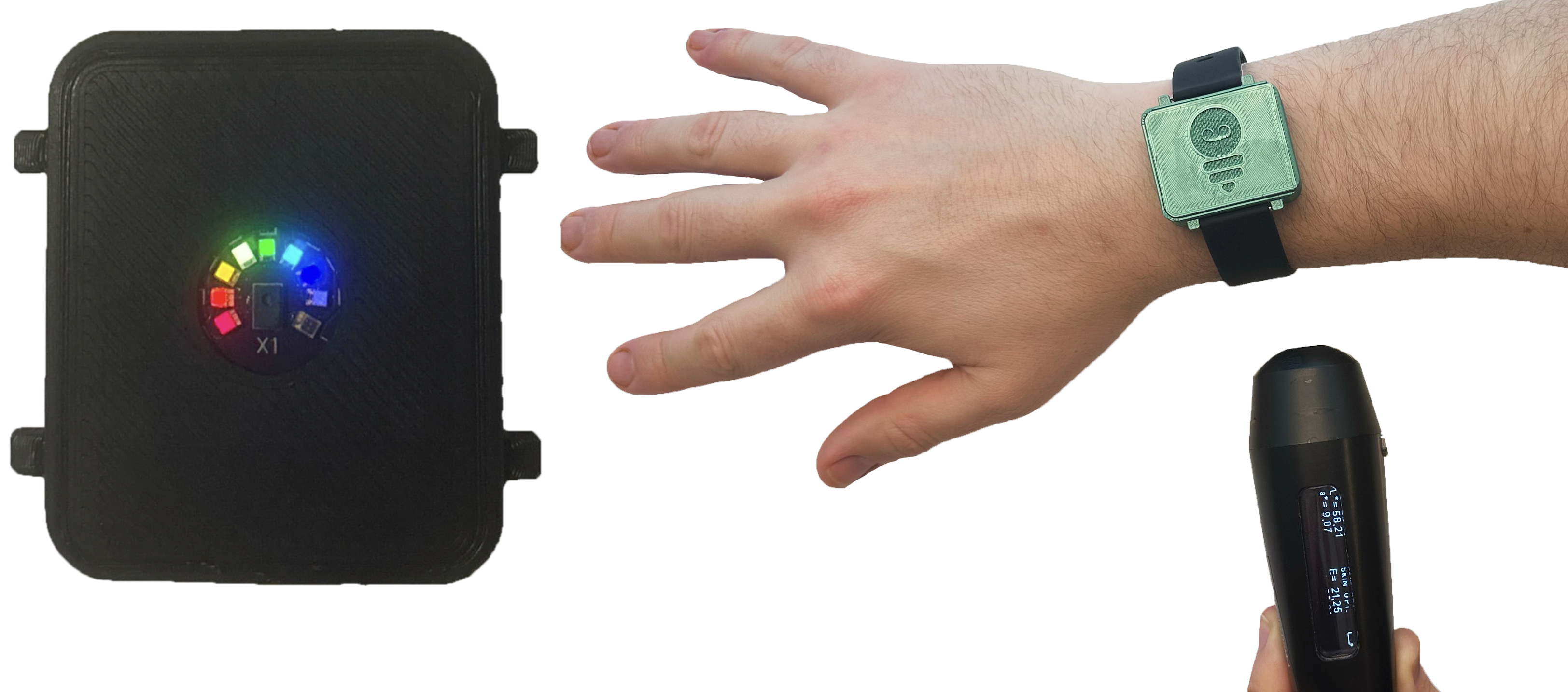
The Oxyvera multi-wavelength wearable sensor
Add device image here
Oxyvera uses multi-wavelength PPG paired with clinical colorimeter measurements as a reference to characterize skin properties.

Broad-spectrum multi-wavelength PPG

We use multi-wavelength photoplethysmography spanning the visible and near-infrared spectrum. Broader spectral coverage allows us to independently characterize the tissue optical environment rather than assume it is consistent across patients.

Beyond skin tone

Oxyvera is designed to produce accurate readings independent of skin tone, skin thickness, and hydration. These are not outlier conditions; they are normal biological variation that current devices fail to account for.

Ongoing clinical validation

We are currently conducting clinical studies to validate this approach across diverse patient populations. Our published research establishes the scientific foundation; this work confirms it holds in real-world clinical settings.

Clinical studies in progress


Research

Built on published science

Oxyvera's technology is grounded in peer-reviewed research. Our published work establishes the scientific basis; more publications are in progress as our clinical program advances.

ACM IMWUT · UbiComp 2025
DermaGlow: Objective Quantification of Melanin, Erythema and Skin-tone Using Wearable Optical Spectroscopy
T. Hamid et al.  ·  Proceedings of the ACM on Interactive, Mobile, Wearable and Ubiquitous Technologies, 2025
Read paper
In preparation
Clinical Validation of Skin-Tone-Invariant SpO2 Estimation Across Diverse Populations
Oxyvera Research Team  ·  Expected 2027
Founding Team

Built by researchers who
lived the problem

Oxyvera was founded at the University of Virginia Link Lab by engineers who encountered this bias firsthand and set out to fix it from first principles.

Tarek Hamid
Tarek Hamid
Co-Founder · PhD Candidate @ UVA
Expert in multi-wavelength PPG systems and designer of Oxyvera's novel skin-tone algorithm. Published in ACM IMWUT, IEEE ICASSP, and IEEE Pervasive Computing. Industry experience across multiple sectors including companies such as J&J and JPMorgan.
AW
Amanda Watson
Co-Founder · Assistant Professor @ UVA
Leading expert in wearable sensing and Principal Investigator at the Watson Research Lab at the University of Virginia. Extensive publication history at top-tier journals such as IMWUT, IJCAI and CHASE. Ph.D. in Computer Science from the College of William & Mary.
CMO
We're hiring!
We are looking for a clinical leader who shares our mission of equitable physiological sensing. If that sounds like you, we want to hear from you.
Get in touch

Interested in working together?

We are speaking with clinical partners, health systems, device manufacturers, and investors who share our belief that accurate SpO2 for every patient is an engineering problem with a real solution.

Email us